Last updated: October 2026

You buy leads, your team dials, and nobody picks up. The problem may not be your leads or your script. It may be the words on the consumer’s screen: “Spam Likely,” “Scam Likely” or “Potential Spam.”
Americans now receive an average of 9.9 unwanted calls a week, according to Hiya’s State of the Call 2026 report, and most people simply ignore a call that looks suspicious. Here’s how spam labels work, why legitimate insurance agencies get flagged, and the steps that fix it.
How a number gets a spam label
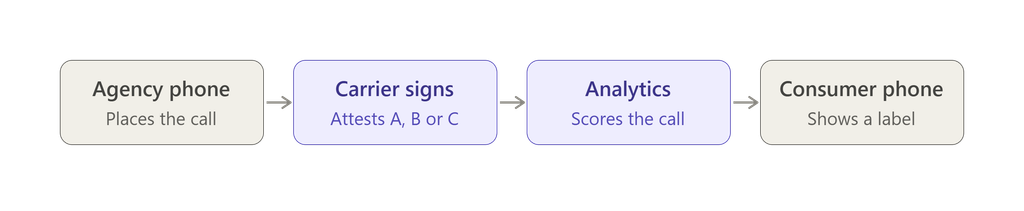
Before your call rings, the consumer’s carrier decides how to display it. Three things feed that decision:
- Call analytics. Each major U.S. carrier works with an analytics company — Hiya for AT&T, TNS for Verizon and First Orion for T-Mobile — that scores numbers on their calling patterns.
- STIR/SHAKEN attestation. This is the caller ID authentication system U.S. carriers use. The originating carrier signs each call with A, B or C attestation, depending on how well it knows the caller and their right to use the number.
- Consumer feedback. When people block, report or quickly hang up on your calls, analytics engines notice.
Each provider decides independently, so the same number can look clean on one network and show “Spam Likely” on another.
Why legitimate agencies get flagged
Spam engines judge behavior, not intent. The most common triggers:
- High volume from one number. Hundreds of calls a day from a single number, especially a new one, looks like a robocaller.
- Short calls and hang-ups. Lots of calls lasting a few seconds signal unwanted calling.
- Dialer dead air. A pause before an agent connects is a classic robocall pattern. Under the FTC’s Telemarketing Sales Rule, a call counts as abandoned if a live rep isn’t connected within two seconds of the consumer’s greeting.
- Weak attestation. Calls signed with B or C attestation get less trust than A-level calls.
- Complaints. Calling without consent, outside permitted hours or after an opt-out creates the reports that drive labels.
- Recycled numbers. A number you lease may already carry a bad reputation from its previous owner.
What it means for your agency: Most spam labels on legitimate numbers come from how calls are made, not who makes them. That means they can be fixed.
What a spam label costs you
A labeled call is usually a lost call. Hiya’s 2026 survey of more than 12,000 consumers found unwanted call volume in the U.S. has grown about 16% a year since 2023, and 25% of Americans say they received an AI deepfake voice call in the past year. Consumers have learned to ignore anything that looks risky.
Here’s a simple example. Say your agency buys 1,000 leads a month at $20 each. If spam labels cut your contact rate from 30% to 20%, you reach 100 fewer people for the same $20,000. It also wastes your agents’ time, because every conversation takes more dials. Every flagged number quietly raises your cost per sale.

Signs your numbers are being flagged
Watch for these patterns:
- Your contact rate drops suddenly, with no change in lead source or script.
- Prospects mention that your call “showed up as spam.”
- Calls from one number connect far less often than calls from another.
- A number performs well on one carrier but poorly on the others.
- New numbers start strong, then fade within days or weeks.
7 steps to fix spam-tagged numbers
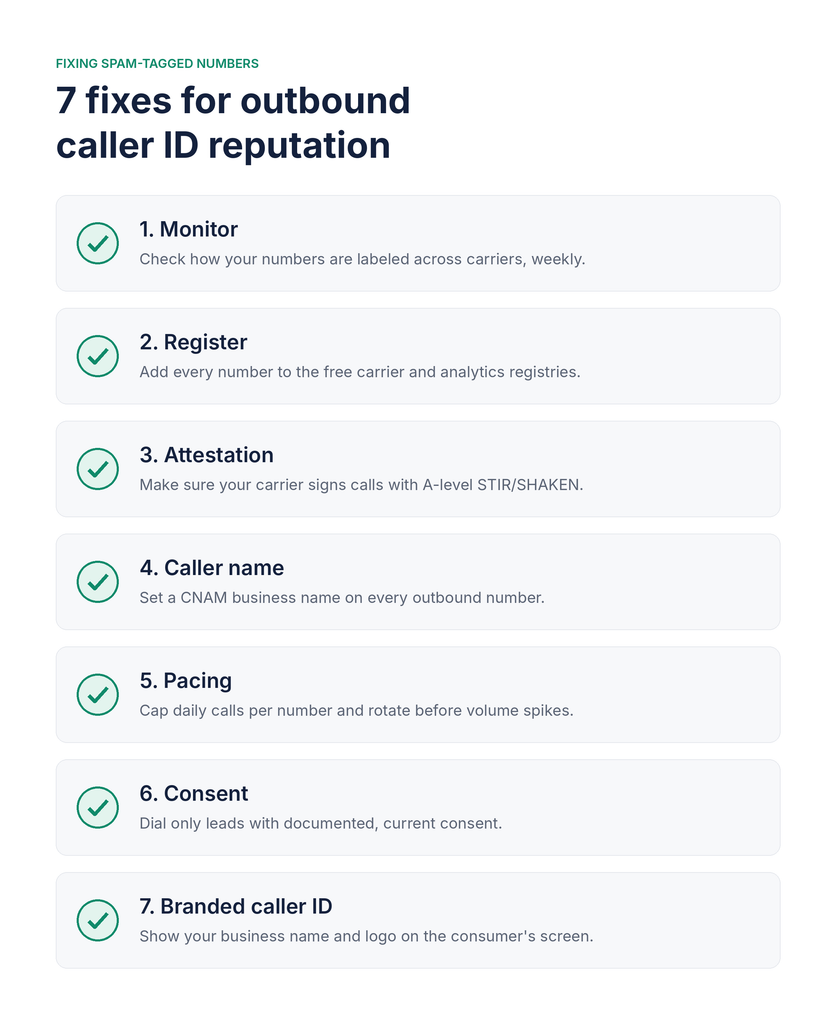
- Check how your numbers display. Call your own outbound numbers from AT&T, Verizon and T-Mobile phones, or use a reputation monitoring service. Check monthly, and every time you add new numbers.
- Register with Free Caller Registry. freecallerregistry.com, run by Hiya, First Orion and TNS, lets businesses register outbound numbers for free. It doesn’t guarantee a label will be removed, but it gives each provider your business details to review.
- Get A-level attestation. Ask your phone provider how your calls are signed. If it isn’t A, move your numbers to a provider that can verify you and your right to use them.
- Register your caller name (CNAM). Make sure your business name, not a blank or a city name, appears on caller ID.
- Pace your dialing. Use enough dedicated numbers for your volume, warm up new numbers gradually, and avoid predictive dialer settings that create dead air.
- Call only people who asked to hear from you. Use leads with documented consent, scrub against the Do Not Call Registry, honor opt-outs quickly, and call between 8 a.m. and 9 p.m. in the consumer’s time zone.
- Add branded caller ID. Branded calling can show your business name and logo on the consumer’s screen. It works best once your reputation is clean; branding doesn’t override bad calling behavior.
If an outside calling team works your leads, ask how it handles each of these steps. Your prospects see that team’s caller ID, so its reputation becomes your contact rate.
Why number rotation isn’t the answer
Some vendors sell “number rotation”: swapping in fresh numbers as old ones get flagged. It hides the problem instead of fixing it. Reputation specialists such as Numeracle warn that analytics engines can recognize rotation patterns and label fresh numbers within a few calls.
Regulators are watching too. In March 2026, the FCC proposed numbering rules that ask whether to limit “number cycling,” which it describes as churning through large volumes of numbers to evade robocall detection. The lasting fix is a clean reputation on a stable set of numbers.
What it means for your agency: Fix the calling behavior and the caller ID, then keep your numbers. Replacing them only resets the clock.
What’s coming next: verified caller names
In October 2025, the FCC proposed requiring phone companies to display a verified caller name on calls that carry A-level attestation. It’s still a proposal, but if adopted, agencies with clean, properly signed numbers will be easier for consumers to recognize. That’s one more reason to fix attestation now. If you’re choosing an outside calling team, see our guide on how to spot a legitimate call center.
Frequently asked questions
Why do my business calls show “Spam Likely”?
Carrier analytics engines label numbers based on calling patterns, consumer complaints and caller ID authentication. High call volume from one number, short calls, dialer dead air, weak STIR/SHAKEN attestation and calls to people who didn’t consent are common causes.
How do I remove a “Spam Likely” label from my number?
Register the number for free at Free Caller Registry, make sure your calls carry A-level STIR/SHAKEN attestation, register your caller name, and fix the calling behavior that triggered the label. Removal isn’t guaranteed, and labels return if the behavior doesn’t change.
Does rotating phone numbers stop spam labels?
Not for long. Analytics engines can detect rotation, new numbers can be flagged quickly, and the FCC has asked whether to limit number cycling. A stable set of well-managed numbers works better.
What is STIR/SHAKEN attestation?
It’s the caller ID authentication system U.S. carriers use to show how well they know a caller. A-level means the carrier has verified the caller and their right to use the number; B and C levels carry less trust and are more likely to be labeled.
Keep your agents talking, not redialing
Lead Miner contacts and nurtures your leads from a TCPA-compliant contact center, with consent, Do Not Call checks and calling-hour limits built in, then warm-transfers interested prospects to your licensed agents.